Showing posts sorted by relevance for query soldier x. Sort by date Show all posts

Saturday, April 28, 2018

Oh Cool, Marvel is Finally Collecting, "Soldier X," and the Earlier, "Cable," issues in a Big Trade!

A good long deal of time ago---2011--I made one of my big sprawling posts where I rambled on about a variety of subjects. In this case it was was the start of the New/Nu52, my love of Tupac's works, and the fascinating and underrated Marvel series, "Cable," in its later issues when it led into the equally stellar and less-known, "Soldier X." The last issues of that run of, "Cable," were #97-#107 and then things wrapped-up with, "Soldier X," over eight stellar issues...followed by three forgettable ones unrelated to the otherwise epic yarn told. Plus, "Soldier X," was never collected in a trade, which sucked. The end of, "Cable," and good chunk of, "Soldier X," were series as dark and disturbing as they were clever and hilarious. Now Marvel is finally collecting all this comic-goodness (and those pointless extra issues) in a big book cleverly titled, "Cable: Soldier X," as I discovered flipping through the latest May 2018 issue of, "Previews."

These books written by David Tischman and Igor Kordey (and illustrated by a number of talented people including Igor Kordey as writer too) are like hidden classics and you owe it to yourself to take advantage of an opportunity to read them without having to dig in back-issue bins or searching about on eBay. You can easily pre-order a copy via Things From Another World or at all finer comic shops. Trust me, don't, "sleep," on these books, as the kids (I think) say! God, I'm old.

Monday, September 12, 2011

"It's About Power and Money" AKA Nu DCU, Soldier X, and Tupac

Opening
This post we have my thoughts about how the "old" DC Universe ended in Flashpoint #5 along with how it began in Justice League #1. Then I say my own thoughts about the highly-popular Cable and Soldier X comics that occurred back in the early 2000s, having been inspired by series of cross-over posts between some writers I really enjoy reading.

Also, tomorrow is the 15th anniversary of the death of one of my favorite music artists, Tupac Shakur. I'll discuss my two favorite albums by him a little bit and why his death matters even if you don't like rap.

Yeah, it's a lot of content to share, but with my new format of only posting every 2, 3, or 4 days I'm hoping you dear readers will drink down every word I type now like a rare can of Surge soda. Remember Surge? That stuff was tasty, and had more caffeine than humanly possible. Yeah, I could go for a Surge if all those cans wouldn't be super-expired.

Flashpoint and Justice League
Flashpoint #5 was a decent comic, even if it pretty much consisted of Barry Allen either standing around doing nothing so Thomas Wayne could (spoiler) kill the Reverse-Flash, or Barry Allen going back in time and undoing all the trouble he caused because--TWIST!--it seems he is the one who caused this alternate reality by making it so his mom didn't die or something. Oh, and in the process these different realities come together and this mysterious woman who is appearing in all the other DC comics in a cameo (probably as a way for DC to have an emergency undo-the-recon-button) spouts some enigmatic gibberish. Then Barry Allen gives Bruce Wayne a letter from his father and Bruce cries because its sweet--of course, it technically isn't our Bruce Wayne as this is the new DC Universe, but whatever. I liked Thomas Wayne and the action was good, so I'm satisfied.
3 out of 5 stars.
Justice League #1 is a fun Batman and Green Lantern team-up comic set in the beginning of the new DC Universe, but it isn't really a first issue of a Justice League book. At least, it doesn't feel that way. It feels like the first part of something that was written for a trade paperback and then suddenly split into a comic-book issue format--the cliffhanger is just sort of weak (Hm, Superman, a fight next issue, eh) and things seem to move sooooooo slowly. Oh, we also meet Cyborg before he becomes a Cyborg and is just really good at football. I don't know, Geoff Johns wrote both this and the Flashpoint books, and Flashpoint #1 jammed in a ton of content, whereas this just seems really decompressed--if I may use a term comic fans often employ. At least the Jim Lee art looks decent.
2.5 out of 5 stars.

Cable and Solider X
INTRO
The Hooded Utilitarian and The Factual Opinion did a series of reviews about the comic book/s Cable and its follow-up Soldier X. There was the first installment, the second, a first part to the third, a 2nd part to the third, and a fourth and final post. I've read the books because I was inspired to pick them up after initially reading this excellent article on Robot 6 long ago.

When I picked up the Cable comics the funny thing is I had to get some before its dramatic shift in focus with issue #97 that lasted to #107 (and made for some awesome comics), and boy, was it a terrible comic. Issue #96 is this lame one-off about Cable helping this ancient huge-man fight these other huge ancient huge-guys because the first one wants a doll he gave to his deceased daughter they stole. Oh, and this ancient huge-guy who has lived so long knows Cable is special because Cable beats him at arm-wrestling and no one can do that. Seriously.

The arc before that is some miserable stuff about Jean Grey having genetic Phoenix sisters or something that no other comic has ever acknowledged so just forget it and a reporter named Irene (who is in Soldier X) has to have her skin color changed from white to black so that she can avoid being killed by this evil cult and learns that racism still exists when a police officer picks on her--so we learn from the comic that racism is bad in this really ham-fisted way! Wow, how touching!

 If you're going to try and talk about racism, please don't just do lame, "Hey, you know racism, yeah, it still exists, shocking, huh?" type stories with someone who was white magically becoming black and learning a valuable lesson--that is just the most cliche, "look at me, I'm a message" type story. Anyways, yeah, they were bad. However, then something awesome happens, namely issue #97 and on.
CABLE #97-107
This here is some good stuff. Basically, writer David Tischman and excellent artist Igor Kordey came in and made this comic go from horrendous to awesome in the span of one issue. Tischman took the idea that Cable is from the future, and has knowledge of how little conflicts in history could grow and become huge problems that lead to the nightmare scenario that mutants face in the future--so why wouldn't he get involved and try to fix things now? This led to Cable going into hotspots around the world and considering that Igor Kordey is himself a vetran of Balkan wars and this comic involves post-soviet areas you know this isn't too fantastical. Also, this comic was happening right around 9/11 and didn't hesitate to address it. Right on the opening of one issue is a drawing of the towers, on fire, broadcast on a television. This comic was about Cable addressing terror around the world, so it noted the fact that yes, terrorism had happened close to home too. It was a serious, clever, and beautiful-looking comic. You can actually get it collected in two trades, "Shining Path" and "The End", and I would recommend doing as such.
SOLDIER X #1-8
There were issues after #8, but screw them because they had writers who missed the point of the awesomeness that was Soldier X. Soldier X was half the time a parody of super-hero comics, at other times it  was about the God-complex we have in regards to super-hero characters, thinking of them as if they are religious figures, and then other times it was just about the futility of violence...in a comic about a character whose main modus operandi was violence--thereby making his own existence pointless. Then again, Cable being pointless was sort of what writer Darko Macan was going for in his darkly funny comic, almost mocking the idea of Cable while at the same time elevating him to a God-like level of power, but with the knowledge that using this power to wreak havoc just proves nothing. Igor Kordey continued to provide great art and its some super stuff. I'm sort of unique in actually maybe liking the Cable stuff a little bit more though--don't skip this Soldier X material however, it's dynamite too.

Tupac--15 Years After Death
Tomorrow, September 13th, will be the 15th anniversary of the death of Tupac Shakur (June 16th, 1971-September 13th, 1996). Tupac was arguably one of the most talented music artists I've ever heard. When it comes to listing the most gifted talents in music ever some names I give in no particular order would be Mozart, Kurt Cobain, Beethoven, Bach, Andre Benjamin AKA Andre 3000 of OutKast, Miles Davis, Coltrane, and of course Tupac (there are other people I'm not listing, but you get my point for whom I think of as "cream of the crop).

Just listen to "The 7 Day Theory" AKA "Makaveli". David Brother's writes his thoughts about it beautifully on the 4thletter; it truly is an album so loaded with textual meaning you could work on "decoding" it forever. I also am a huge fan of "Me Against The World" easily saying those are my two favorite albums by Mr. Shakur. Just listen to "Death Around the Corner" and tell me the paranoia and despair doesn't seem to just hang in the air around you as the song plays--or as a complete counter, try "Dear Mama" and see just how gentle and sweet Tupac could be. In contrast, to go back to his last album he was directly involved in before his death and the first to be released posthumously, "Makaveli" has some incredibly incendiary tracks. "Bomb First (My Second Reply)" is pure fire.

There are also some love songs. "Just Like Daddy" is both sweet and dark, talking about love and how it's pretty much about young women with daddy issues. There is also, "Me and My Girlfriend," which for those of you who are a bit slow with metaphors, is in fact about guns. Listen closely and you'll catch on. Yeah, the Jay-Z and Beyonce version completely ruined it and missed the point, but never-mind that. Don't forget the inspirational songs like, "Hold Ya Head" which even in trying to be supportive carries an air of depression--something you find often with Tupac. My point is that the man was a lyrical genius, and no slouch when it came to contributing to the production of the tracks either.

By the way, my favorite Tupac song is a tie between "Lord Knows" and "Outlaw" on "Me Against The World". A close second are both "Life Of A New Outlaw" and "Bomb First (My Second Reply)" on "The 7 Day Theory"/"Makaveli".

There is plenty more I could say about Tupac, but I just wanted to say, this was a man who had incredible lyrics that spoke so much truth, and carried so much sadness, but with a glimmer of hope--but always with that darkness. The best way to sum it up is how on, "Just Like Daddy," it is being said by a member of the Outlawz (E.D.I.) that a young woman a he met was, "A diamond in the rough, the kind that you can love, not yet touched but so much..." and at that moment we hear Tupac quietly come in saying, "Pain" before E.D.I. states, "Potential." That bit says so much, that its the pain that Tupac jumps to. There was so much sadness, but that slight tiny bit of hope he had was what made things all the more beautiful.

Then he was murdered. We still don't know for sure who did it. It happened 15 years ago tomorrow. Life is a real bitch sometimes.

Sorry to end on a downer, but sometimes that's how things are.

Sunday, December 26, 2010

Not quite terrible, but definitely not good: X-Force & Cable: The Legend Returns

X-Force & Cable: The Legend Returns
Before Uncanny X-Force (a great comic) there was the X-Force who were a secret team led by Cyclops, and before that there was this six issue comic that took the X-Force vibe from the 90s and brought it back. I like Liefeld's art somewhat unlike many people, so why didn't I like it?

Sunday, September 15, 2024

Go Read a Fascinating Bill Jemas Article in the Latest, "The Comics Journal," Issue!

The Comics Journal used to come out monthly but some time ago shifted to having short website articles and fascinating pieces of long-form journalism in a yearly-ish edition the size of a hefty novel. The 310th issue recently came out and contains a fascinating examination of how Bill Jemas arguably saved Marvel from going utterly insolvent in the 2000s through all kinds of wild and weird ideas before being let go because the company regained stability and no longer had any space for the wild and weird ideas. The TCJ website has a preview of the big piece you can read, but I'd frankly say you should just get yourself a copy of the latest issue and delve into the fascinating character that is Jemas. 

Is Bill Jemas a man with passion or a bully? Someone who takes calculated risks or a foolhardy gambler who managed to strike it lucky just often enough to keep going? A hero to those he helped like Mark Millar and someone to be compared to Darth Vader by others he enraged like Tom Breevort. I have to confess I have a fondness for the era of Marvel under Jemas' tenure as it brought us the wildly inventive Ultimate Universe, the Marvel Max line, Morales and Bakers' "Truth," Grant Morrison's amazing, "New X-Men," (although that ended after a number of screaming matches via the phone between Morrison and Jemas) and other inventive stuff like a superb run on, "Cable," that morphed into the surreal, "Soldier X." This isn't to say the time Jemas spent at Marvel only put out bangers, there were plenty of flops and outright bizarre misfires--remember, "Marville," my friends? That said, the TCJ article points out it was the last time Marvel seemed to really be trying something new and different as opposed to, "Safe," content that wouldn't rock any corporate boats too much (Disney, after all, did buy Marvel back at the end of 2009).

It's a great article that paints a complex and at times contradictory picture of Bill Jemas, a man who at the end of the day feels he is right, and sometimes he is! In my own dealings with Jemas he once wrote me when I posted negative initial impressions of the comics from one of the publishing lines he was a part of post-Marvel, Double Take comics. He sent me an email stating how he felt if I read more than the first issues of various series I would get a better feel for everything and like a lot more the line's output. Jemas sent me in the mail a bunch more stuff to read. He was, in fact, correct, and I liked the Double Take stuff before the line folded and Jemas went on to some other endeavors. Jemas is an interesting person and, "The Comics Journal," gives us a fascinating and juicy article about the fellow. Go get a copy from your store of choice or the publisher Fantagraphics itself. The rest of the issue is full of great reading too!

Friday, July 17, 2026

I Appreciate Joe Casey Discussing Some Companies Generally Paying Less Royalties Than They Should

Marvel seems to do this thing where if you create a character under their work-for-hire system and they use it in a movie/show, they'll give you a check...but are very careful about it. They aren't giving you a royalty; it is $5,000 and an invite to the premiere of the thing with your character...as long as you signed some contracts too, where they're protected from you suing for more money or speaking out about things too much in a critical manner. I mean, Ed Brubaker got more money for filming a cameo in, "Captain America: The Winter Soldier," than what he made on the character being in the flicks (yes, yes, there is some argument about how he took an established character such as Bucky and did Winter Soldier, I know). Joe Casey has done quite well with a number of projects and didn't feel like he needed to sign any paperwork for Marvel using America Chavez in, "Doctor Strange and Multiverse of Madness," or now for William Metzger (being played by Tramell Tillman) in, "Spider-Man: Brand New Day." Metzger was created by Casey and Steve Rude back in the 1999-ish mini-series, "X-Men: Children of the Atom." He just feels that if a character is being used a good deal in a production, perhaps the millions being spent (and made) can have a decent check go to the person who actually invented this (hopefully) profitable property.

Casey isn't outright enraged at Marvel; he still works with them on occasion. Still, Casey feels, "For me, it’s not about money. It’s not even about the respect. I would never expect to be respected by a corporation...If I’m in a position where I can afford not to take their insult of an offer, and be able to talk about it, maybe the next guy — where that kind of money could change their life — would get a fair shot of receiving that money.” An honorable sentiment from a creator who can turn down a smaller check and talk about thanks to other successful projects (he and Joe Kelly did well with, "Ben 10," for sure, to name one thing). It goes to show that when you're doing work-for-hire in the comic industry, you could make something insanely popular and barely see much extra scratch for it. At least if something creator-owned fails to strike a chord in the market, you still have ownership.

Friday, May 8, 2015

Film Friday: It's Been a Week Since "Age of Ultron" Came Out so I'm Gonna Share my Spoiler-Filled Thoughts/Review

We've All Seen it, Right?
So, "Avengers: Age of Ultron" came out a week ago in the U.S. (technically eight days ago if you count the Thursday evening-showings). I've seen it, and would say I greatly enjoyed the flick, even if it is not necessarily as good as the 1st "Avengers" or "Captain America: The Winter Soldier". Considering how the newest entry in the Marvel Cinematic Universe basically made a big ol' bunch of money I am going to assume you have either already seen "Age of Ultron", or don't mind being spoiled if you're reading this. Should you have missed the title however, I'm going to spoil basically everything as I share my thoughts...

My Scattered Thoughts
Somewhat Mixed Reviews On Deck!
Whereas the first "Avengers" movie had absurdly-high expectations and actually delivered on them quite handily, this newest yarn seems to have reviewers a bit split. People love the special effects and quiet character moments, but some complain of it feeling bloated at its 2 and 1/2 hour running time, or worry about a sensation of character-overload from all the heroes and villains who appear (the Baron got very little screen time despite having a solid actor in the form of Ralph Fiennes). I myself do agree that toward the end when literally everything was happening at once it could be a bit chaotic, with me wondering, "Wait, Thor and Ultron have been fighting the whole time while everyone else did their thing?" but I still thought it was good to get some fresh faces thrown onto the screen. Some of the original cast won't be around forever, so having someone young who can play Scarlet Witch (Elizabeth Olsen) for the next couple of decades is a good plan considering folk such as Chris Evans have made it clear they don't want to still be playing super-heroes when they're eligible for Medicare.

Relatively Stand-Alone
Even though to completely appreciate the Marvel Cinematic Universe you need to see all the films (well, maybe not "Incredible Hulk) this actually stands pretty well on its own as long as you've seen the first "Avengers" movie--and it's helpful to have seen "Captain America: The Winter Soldier" so you know why S.H.I.E.L.D. is no more and who Anthony Mackie's character is that hangs out with the Avengers (along with how that, "Missing person," he references is of course Bucky). That said, various characters get a mention here-or-there and maybe appear briefly (Idris Elba is always a treat to see), but you can basically watch this without having to know a ton about the movies. Even the brief mention of the Infinity Gems/Stones isn't too confusing, but does help to tie-in the otherwise yet-to-be-directly-important "Guardians of the Galaxy" to the other Marvel flicks.

A Delightfully Evil Ultron
We have all made fun of Marvel for not having any good villains besides Loki. Their bad-guys seem to either die too fast (Red Skull) or be completely forgettable (that Elf-guy in Thor, the Kree in "Guardians of the Galaxy" who has a name I can't even remember now even though he's important in the comics). This trend is thankfully stopped or at least interrupted by Ultron. Voiced deliciously by James Spader, Ultron has a seething hatred for humanity you can hear through his quips and comments. Even though he seems to be dead and gone at the end of the movie, it wouldn't surprise me if he pops back-up.

Justice Was Done For/To Hawkeye
A lot of "Age of Ultron" seemed to basically be a big apology to fans of Hawkeye who were still upset about his treatment in the first movie. We see a lot of the hero's personal life with his wife and kids, have it pointed out how even though he simply is a guy with a bow and arrow this normal humanity is what actually makes him an important member of the team, and basically Marvel says, "We're sorry, please quit sending us hate mail, Hawkeye lovers. All four of you. Sorry, we just did it again, we can't help ourselves." It is also interesting how the movie really built things up to make it seem like Hawkeye was going to die, when in fact...

The Quicksilver and The Dead (Yes, That's an Awful Pun)
Not to be confused with the version in the "X-Men" movies...
As he says after getting shot full of bullets, "Bet you didn't see that coming." Yes, Quicksilver dies and even though there may be alternate footage where he survives, as far as the official Marvel Cinematic Universe goes he is no more for this world. While we have seemingly seen people die in the Marvel movies only to have it revealed they are alive and well, I actually could see this sticking, maybe. I'm honestly just glad Marvel introduced another female Avenger in the form of Quicksilver's sister, Scarlet Witch, considering how besides Black Widow there ain't much gender diversity on the team. I just was surprised Marvel had the gall to kill someone off considering how any of these characters are walking piggy-banks of merchandising. Then again, with Spider-Man appearing in a Marvel-movie before too long there should be plenty of money falling from the heavens shortly.

What Superman Couldn't Do
I have seen multiple articles (here's one, and here's another!) that point out how throughout the movie we witness the Avengers doing something Superman didn't do in "Man of Steel." Namely, they care about innocent lives and take great pains to make sure civilians are clear of conflict--expressing great concern at times regular folk find themselves in harm's way. Even a major plot element is how the team tries to evacuate the chunk of land Ultron wants to use as a weapon (this effort to save everyone of course leads to Quicksilver's aforementioned tragic death). In "Man of Steel" We see Metropolis be utterly decimated and its made clear a whole bunch of people die. It seems this may be an important plot-point of "Batman VS Superman", with the former using the destruction as an excuse to be mad at the latter, but it is kind of interesting to think that the traditional beacon of hope and all that is good (Superman) actually seems less concerned with human life than the Hulk (well besides in the mind-control scene where the Hulk freaks-out).

The Vision Was Cool
That really is all I have to say about Paul Bettany as the Vision. It was pretty neat. I loved when he just casually grabbed the hammer. That probably was when the theater I was in laughed the loudest with surprise.

Concluding Thoughts
"So...you liked it?"
I really enjoyed "Avengers: Age of Ultron." It may not be the best of the Marvel films, but is definitely in my own, "Top 5," of all the films. It has action, humor, quiet moments to compliment the many loud ones, and is otherwise a great time. Plus, most important of all (to Disney/Marvel, at least) it gets me excited for the future movies.
5 out of 5 stars.


...Ronan, the Kree's name was Ronan! I knew I'd remember it eventually!

Sunday, January 9, 2022

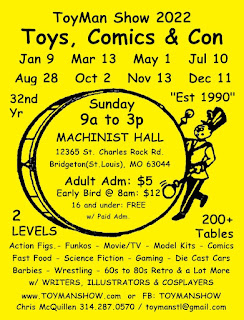
ToyMan's Debut Show of 2022 Was a Delight

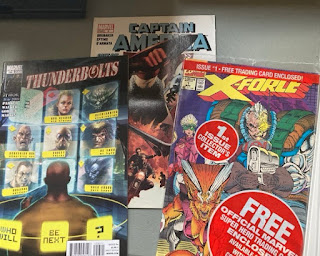
I was able to briefly swing by ToyMan early in the show today and enjoyed seeing a lot of great vendors and creators. It was a superb event--as always--and I picked up some snazzy comics. There is a lot more than comics as you all know (toys, Funko, video-games, records, Lego, etc.) so if you come to a show you're bound to find something in your niche. As for what I did, I kicked off the show chatting with Spike of Lost in Space Toys and Collectibles before saying hello to my friend Tim Metzger--he had a bunch of cool comics, DVDs, and more. I chatted with John Chaffe from Bigfoot Comics and Collectibles, as he's always lovely to interact with. I cut a deal with Vince from VK Toys and had the pleasure of acquiring a, "Thunderbolts," comic from a past run I enjoyed, a polybagged, "X-Force," #1 and a sixth issue of, "Captain America," which is the first full appearance of Bucky as the Winter Soldier. Here's a pic:

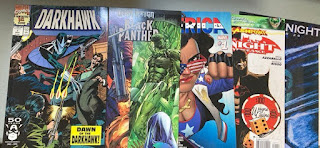
Upstairs I saw my two friends Jessica Mathews and Jennifer Stolzer selling their awesome books and other snazzy wares. I also chatted with the folks behind Heroes for Kids of Perryville, Missouri about all the great work their nonprofit continues to do. I continued browsing around and also ran into my friend Eric of PJ Comics and Collectibles for whom this was his first ToyMan as a vendor! He had some awesome comics I acquired via some trading that you can see here:

The ToyMan show today was a hoot. I saw so many awesome vendors and friends, enjoyed checking out all the goodies, and got some awesome comics for myself. There is always just so much at ToyMan to see and I'd encourage you to go to the next show on March 13th to observe all the awesome stuff for yourself!

Friday, January 17, 2025

"Ultimate Wolverine," #1 Gives us a Mystery Wrapped in Brutality

"Ultimate Wolverine," is the latest of the (thankfully slowly) growing Ultimate line of comics. Marvel's latest venture into a new Ultimate Universe has actually been fantastic, with each issue moving time ahead one month--a feat that is still somehow working--and telling interesting stories around this World that The Maker altered in countless twisted ways. The Ultimate iteration of Wolverine has some hints dropped about who he is/was, but much of the comic centers on the heads of Eurasia (Colususs, Magik, and so forth) using their, "Winter Soldier," as he is dubbed (no relation to Bucky) to enforce their mutant rule in the region they control. 

The mutant weapon we witness was once called Logan, we learn, and part of the opposition to this tyrannical government, but a lot is left unclear. It also appears Wolverine won't be waking up anytime too soon as the first mission has him murdering his old friends (Mystique and Nightcrawler) in a shockingly detailed manner. I cannot compliment artist Alessandro Cappuccio enough, having become a huge fan of the artist during his time on, "Moon Knight," comics. They do an amazing job with, "Ultimate Wolverine." This isn't to ignore how writer Chris Condon is setting up a whole lot of interesting plot beats in this debut issue, I just can't stop admiring how simultaneously gorgeous and grotesque Cappuccio's work is. I'm loving almost every Ultimate Universe book currently ("Ultimate X-Men," is alright but drags horribly), and this latest title is a fantastic new entry into this line.

5 out of 5 Stars.

Monday, April 4, 2011

A Bunch of Links.

Hey, how about some news?
Well that is what's happening in the world of comics and the world of, um, the world. Try and keep safe out in that crazy world, ya'll.

Monday, March 9, 2026

Tom Brevoort Wants to Make Me Angry--and I Kind of Understand Why

Tom Brevoort works at Marvel, and he wants to make me angry. Not specifically me, however, that would be upsetting. He Marvel Executive Editor, SVP, and Senior X-Men Editor, and he discussed recently how he basically believes that it is better for fans to be furious/angry/otherwise perturbed about a storyline than simply indifferent. If Marvel can stir passions in fans--even objectively, "Bad," ones, that's better than folks shrugging and being bored. I see what he's getting at. I mean, "Secret Empire," was an awful comic, but it had an interesting--albeit odd--idea to have reality-warping powers make Captain America a secret sleeper agent for Hydra. Many fans were angry, but we checked the comic out to see what happened, didn't we?

This reminds me of when I'm watching, "Saturday Night Live," and a really weird sketch comes on. Even if it isn't hilarious, I always say, "I'll take weird over boring." A sketch that is simply dull won't garner laughs or discussion, but if you get really strange with it, that can keep my focus (and if I laugh, too, it is a win-win). Having a comic that makes me angry, piques my interest by being weird, or otherwise stirs some kind of emotion/thought is better than a book I pick up, read, and can barely remember due to how uninteresting it was. If you do something purely for shock value and don't have much substance to what happens, it can backfire. Sometimes doing something utterly shocking can have a remarkable payoff, however. I mean, to stay on the subject of Captain America, a lot of fans were beside themselves when Bucky was brought back from seemingly being dead decades later  (in our real time, not comic-book time) as the Winter Soldier, but that is now regarded as one of the better storylines ever told within a, "Captain America," comic! Even if Hyrda-Cap was a swing-and-a-miss, that earlier storyline was a homerun (and you can't win them all, clearly).

Tom Brevoort wants me to be angry, because at least if I'm angry, I'm not bored. It makes sense, but people can eventually just burn out if you keep simply trying to get their attention with a dumb gimmick. "Spider-Man and Mary Jane aren't married now! She has kids with another guy named Paul...and the kids are metaphysical creations who disappeared, but she's sticking with Paul! Oh, and she's Venom now! Plus, she is leaving Paul, but not getting with Spidey!" and so forth for anyone who has followed the latest (main continuity) Spider-Man. I don't really care about Paul and the, "All-New Venom," comic with Mary Jane is decent, but a lot of people just got whiplash from how rapidly things shifted in a manner that seemed simply designed to constantly infuriate readers. Again, at least the Venom stuff has been fun, but all the stuff leading up to it was insanely off-putting...as Brevoort perhaps wanted, regardless of if it got a bit exhausting.

I'm not personally upset with Tom Brevoort and know he isn't trying to bait me or anyone directly (anyone who sent him death threats about various comics, as he recounts, is taking things way too far). He wants to keep fans engaged, though, and if doing a storyline that ruffles feathers helps accomplish that, then yeah, he's maybe doing something right. I'll take a rage-inducing and/or weird Marvel over a boring one. If anything, the company needs to do something a bit strange or upsetting right now to get more attention in the comic-book market. Go ahead, Tom, make me mad!

Saturday, June 9, 2012

Project Comic-Con Day 1 Mega-Overview

Intro
I'm back from Project Comic-Con after spending many hours of the day there! I had quite the fun time, meeting many nice creators, vendors, and other assorted folk.Yes, even little ol' me with my often sarcastic and cynical outlook had a really good time, probably the most fun I've had in awhile. Let's do a big overview of a chunk of the stuff I did and the interesting people I met--some with helpful images from the Project Comic-Con website to tell you more about them! This isn't in perfect order of how I did stuff, but it's pretty close.

It Begins
I arrived to Comic-Con at around 9:50 AM or so, and even though it didn't officially start until 10 AM everyone was already being let inside--so yah for not having to wait! Upon going in I spoke with the pleasant Jim Valentino. He is one of the founders of Image comics and the guy behind the brand within it, Shadowline. We and some other fans chatted about comics, he showed some upcoming Image stuff, and I complimented how with all the hubub about creator's right at the moment (you know, with the Before Watchmen business) Image has been getting a bit more attention for how it lets people have their own intellectual property and such. He said from the start they've been about creators rights, that's one of the reasons behind Image's founding and he believes in it. A cool guy. Here is the Shadowline Website.
I stopped by the table of Kenneth Rocafort who some may know for his current artwork on, "Red Hood and the Outlaws." Yes, it did have some controversy at the start with the character Starfire and her behavior, but that was the writer, and regardless of that the book has and currently does look pretty darn good, with Rocafort's kinetic-action style of drawing. Plus, the guy couldn't be nicer. I told him how I enjoyed the way he drew Jason Todd and he said it was fun character to draw. Also, a young girl whom had drawn Iron Man with crayons was at his table and traded it with him for a very snazzy-looking drawing of X-23 he made for her. While the Iron Man drawing was cute, I think getting fully inked and colored drawing was a pretty sweet deal, showing how nice Rocafort is. Here is his site.
I spoke a bit with Micke Mckone,  whose work on Avengers Academy I've enjoyed, he was busy so we didn't talk too much, but he was nice just as everyone else was at the event. Here is his Facebook.
I also ran into a man who was probably one of the friendliest guys at the show, eager to hear about my blog and everything else I do. Plus he looks like a clown (literally) and made a great series known as the Oblongs. Yup, I ran into the famous (infamous?) Angus Oblong. I have proof I survived our encounter:
He was very funny and a joy to chat with. Anyone reading this who hasn't seen the Oblongs ought to, it is both depressing and funny. Depressing because if you think about it the main plot is that of social disparities between wealthy people at the top of the hill and deformed poor people at the bottom. Funny because Oblong has a twisted sense of humor that takes that premise and makes absurdly hilarious situations out of it. Here is a link to his site.

I also spoke with Joshua Dysart, who has done a lot of stuff, but I've most enjoyed his run on Unknown Soldier for Vertigo. It's worth checking out. It discusses the conflict in the Sudan in a way that is both tasteful while still making fora great story. His website is here.
I of course talked to the famous Denny O'Neil. I told him how much I loved his work on The Question--which he told me was one of the favorite things he wrote! His wife was with him too and she was very sweet. I went to a panel where he spoke about comics, and his thoughts about how continuity can useful when used logically but can't weigh you down ring especially true as writers try to explain everything and take every past event in a heroes life into account instead of just having fun with a tale. As of now I couldn't find an official website for him to share, but I do have this picture of us:
His wife was nice enough to snap it, the reason he has that look on his face is not because I am suddenly just popping up behind him and snapping a pic, but we were having issues getting my phone to take the picture and he was worried if it would work. On picture three it did!

Also in the morning I met the creators of the webcomic Nextuus and plan to check it out as they told me it is sci-fi and I do enjoy that topic. Here is a link.


At this point I took a late lunch
After all these creators and some booth-shopping at this point I took lunch. I went out of the event center and had a buffalo burger as readers of my blog will know with my beef allergy I can't eat cow. Yes, cow. I know I'm a horribly weird person. Anyways, after lunch I returned to the event center...

Afternoon


I had a lot of fun talking with Steve Lightle. I talked with him about his past Doom Patrol work and how to make comic characters interesting without making them seem too "different". We also talked about how characters get relaunched in ways that aren't always familiar and how that can work out well and not so well. He was working on a sketch for someone and they came by to see how it was going and I think they were a bit dismayed I had been taking up so much of Steve's time talking to him for quite awhile about comics!

On my way to meet Cullen Bunn I met one of the individuals behind the Comic Book Showdown. I tried Podcasting on my blog some time ago but it just didn't seem to be getting many listeners and all that editing and recording can take a bit of time, so I admire anyone who puts in all that work. Why not give them a listen? Just follow this link.
I then met Cullen Bunn and he was a fun guy. We chatted a bit about his new work on Wolverine, and I told him I had heard lots of great stuff about The Sixth Gun and had been meaning to check it out. He's also going to be writing Venom soon, so he's doing all kinds of new projects for people to start reading. He can be found online here.
Readers of the blog know I am a fan of alt-culture magazines, and at the convention I met Caesar Crawford, the owner/creator of The Dead Timez. He was fun to talk to; we discussed tattoos and how while I think they can look neat I am terrified of getting that many needles repeatedly shot into me (so yeah, I'm never getting one). It's a magazine about, "Local & Independent Art, Music, Film, and Entertainment." I picked up two back-issues and look forward to checking them out! Here is a link to them.
I met Robert Atkins and we discussed how I enjoyed his work on Heroes For Hire. He is doing a neat thing where he makes a sketch a day for all 366 days this year. I told him with it being a leap year he should have taken a day off and just done 365, but the man is dedicated. Here is his site where you can see all those sketches and more.
I met the creator of those Mini-Marvels comics I love and the popular G-Man series, Chris Giarrusso. He was kind enough to give me his card which he joked can be used as a bookmark. You can find his stuff here.
I met some guys behind an independent comic, I've got the first issue and the next one will be the 99th. You heard me. In a clever twist the first issue tells how the main character was born and the next will be about his death. That's a fun idea, and the comic is pretty wacky fun from what I've flipped through so far. You can learn more about them here.

I met the creators of  the webcomic Camden Bottoms. The art style for it is very snazzy and worth a look. Here is the link.
I stopped by the table of Dennis Hopeless and told him how I enjoyed Legion of Monsters, which he thanked me for. Link, here, you know the drill.

I met a neat artist with a cool style named Neil Fitzpatrick. The characters are adorable and the huge black eyes are both cute and creepy (in a good way). Find more of him here.

There was a table with a writer and artist who have a comic about a Gargoyle by Moonlight. It looked fun and the whole issue was a big self-contained tale. They gave me a link but when I go to it it currently says it is under construction. That may change soon. Here it is.

I also met a webcomicker behind Frik'In Hell. A tale of a medieval warrior who works in Fast Food. It's a comedy comic. Here is a link to the first episode.

The Day Ends
As the convention started to close up at 6:00 PM I put the bits of stuff I bought in my car and went back for the after-party. I was tired and needed to get a late dinner so I didn't stay too long. I had a really fun day and plan to be there again tomorrow. I will be getting there a bit later because lord knows I need some sleep after all the stuff I did today! As always, we owe thanks to the 2 guys behind this, Steve of the great Newcastle Comics and Jeff.

Friday, January 16, 2026

Interview Time: Christopher Priest

 © Christopher Priest

Readers may recall I had the pleasure of meeting the talented comic creator Christopher Priest at GalaxyCon. Following that, we kept in touch, and he agreed to do an interview for my blog! I greatly enjoyed speaking with him via email, and I now present the interview...

 © Christopher Priest

Can you start by introducing yourself? You have quite an impressive body of work, of course!

When I was 19 years old, Larry Hama told me whatever you're doing when you turn 45, that's what you do. Well, 45 is way in my rearview mirror now, so I suppose I am a comic book writer. I'm not sure it was ever my goal to become a comic book writer. Mom wanted me to be a lawyer. But here I am.

Jim Shooter hired me as an intern when I was 17. I was trained in visual storytelling, editing and writing by Shooter, Stan Lee, Larry, and ultimately Danny O'Neil. Over four decades I’ve had the privilege of working on a wide variety of projects and characters with extremely talented people in an industry I love.


You've written for Marvel, DC, and a number of indie series, taking on established characters. You've created characters on multiple occasions as well, such as how you co-created the beloved Quantum and Woody. How does the process of making a comic differ when you're writing an established hero/villain, etc. as opposed to someone you've been involved in the creation of?

Well, when you're working on your own creation there are no set rules and obviously no continuity issues exist. You're working from a blank screen which is a little terrifying to be honest, and you're trying to find something original to say in a business where virtually everything that could be said has been said.

Now, when you're writing an established character within a shared universe, that's a different sort of challenge because there are all of these flags set out along the way. So it becomes kind of a game of skill to work within the rules without breaking them, and to honor what has come before without ignoring it or, worse, retconning it.

Your run on Deathstroke was superb. I joke with people, I always said I did not like Deathstroke, then when you were writing him I suddenly loved reading about the character...until the series ended and suddenly Deathstroke bored me again! The mix of action and family drama was a hoot in the series, and many of my friends loved the run too. Was there something specific that made you want to write Deathstroke when DC kicked-off the, "Rebirth," era and you did the series?

I think “want” is maybe too strong a word. For a long time before Deathstroke, I wasn't writing anything. I assume we get into that in the next paragraph. So when the opportunity to write Deathstroke presented itself, I gave that a lot of serious thought and asked myself what I always ask myself when I approach the superhero genre: what would this guy be like if he was actually walking around in the world I live in?

I prefer to write realistic, grounded takes on these characters, mostly because I believe that, for the most part, that’s where the audience is. By “grounded” I don’t necessarily mean “dark,” my Deathstroke certainly was not “dark.” But it was fairly realistic. I feel like, the more “real” we make the work and the characters, the more vividly the larger-than-life aspects will “pop.”

In 1970, Denny O’Neil briefly wrote a very grounded Superman, collected in DC Finest: Superman: Kryptonite Nevermore. If you’ve never read that, do yourself a solid and pick it up. It certainly was not “dark,” neither was my Superman: Lost. But, see, I do not believe Superman (or any Kryptonian) can fly faster than the speed of light. It’s absurd to believe that and it kind of insults the intelligence of our audience. Superman is only “super” under this set of very specific conditions, conditions that rapidly shift as he moves through outer space.

 © Christopher Priest

So Superman (or Supergirl, with all due respect to the brilliant Tom King) planet-hopping is Silver Age nonsense. Absent a Green Lantern or, say a magical Black Adam to tow him to the next galaxy, it would take years if not centuries for a Kryptonian to make those kinds of journeys. My position puts me at odds with the current vision for Superman, which is most likely why I am not writing him. I just tend believe a more reasonable and rational, science-based Superman would have broader appeal than Silver Age Magic Guy, where the absolute horror of outer space, of a black infinity of cold death, is routinely diminished with a handwave as any number of gaudily-dressed characters effortlessly traverse infinity in a page turn with little or no fear of being lost forever.

With all due respect to very talented people who make way more money than I do, I think the heightened reality within superhero comics that is now coming across as a bit tired and condescending because it’s really not 1966 anymore. The audience has moved on. We are writing for a mainly adult audience which is more sophisticated and who demand more of us. Avengers Endgame is a great example of that, of the audience moving on and becoming more sophisticated than the genre itself. So now something like James Gunn Superman feels indulgently nostalgic and people are celebrating a move away from Zack Snyder, but I think they're celebrating it for the wrong reasons and I think that it was a bit of an overcorrection for the Snyderverse to move into such a heightened reality that not only relies on the audience's suspension of disbelief but asks far too much of it (while making Supes largely a guest star in his own film).

I was Marv Wolfman’s intern when I was a teenager, endlessly copying pages out of Tomb of Dracula. I have an enormous amount of respect but also affection for Marv and for his characters. I wanted to do something that was distinct from his run with Mr. Slade while not violating Marv’s canon. I wanted to take what he did and evolve it a little. And where I landed was Hugh Laurie’s FX show, House MD.

The show fascinated me by presenting this tragically broken individual, a man who loved and wanted to be loved but who was capable of neither. A person who was completely unable to sustain intimate relationships of any kind, even with his best friend. The writing on that show was just so awesome, and I borrowed a lot of those themes for Deathstroke.

Deathstroke has always existed as a book about the world's greatest assassin, which I now find to be rather trite and passe. So, instead, I wrote about the world's worst dad; a guy who loved and wanted to be loved but who was incapable of either. A man who would put a hit out on his own daughter in order to spend time with her “protecting” her from nonexistent assassins, and who would sleep with his son's fiancé to keep him from marrying someone unworthy of him.

This prompted a lot of stress with the then-bosses at DC, a company that wanted to exist within the heightened reality I mentioned earlier. In that environment, there was a gravitational pull to make Deathstroke or, say, Black Adam, an antihero, which is incredibly incorrect.

Deathstroke is a murderer many times over who has corrupted many people, least of all his own son and the presumptively underaged Terra. Black Adam destroyed a neighboring country, murdering perhaps hundreds of thousands. These characters cannot be redeemed. Trying to move them to the center because their name is in the title of the comic book is misguided. The theme of my Black Adam series was, “There Is No Redemption For Black Adam,” something Black Adam himself acknowledged and accepted, so his series became ultimately about legacy, about leaving something better behind because he himself was surely destined for hell.

Speaking of your time on, "Deathstroke," I noticed how you've been making comics for literal decades, but when looking at your oeuvre, there seems to be a good 8-10 years around the earlier 2000s where you did not create much comic-book work. Is there a reason for that you'd be comfortable discussing?

Sure. At some point, I have to presume it was after Black Panther, the industry stopped relating to me as a writer and began relating to me as a “black” writer, a writer with an adjective. People tend to treat such modifiers, “black,” “female,” “gay,” “Your Adjective Here,” as “Less-Than.” I somehow became “Less-Than Writer Christopehr Priest.” Labels are bad, David. Labels categorize individuals, which is why I dislike being referred to as an Adjective Writer. As Less-Than Writer Guy.

During those years I was frequently approached for work, but I was being offered work exclusive to my category, with my pitches for mainstream characters being routinely rejected. So I just did other stuff. I began working in ministry, working with a network of local churches and eventually pastoring two. There is an archive of my online ministry at http://priasnet.org.

There was some mention made recently to my career as a bus driver, which is true, but the chronology was wrong. The bus thing happened way before the 2000’s. I quit comics in 1988 and trained as a bus driver mostly as a lark. As a kid, I’d always wanted to drive busses but Mom was having none of that. The online mentions depicted me as a victim down on his luck post-Panther and post-Milestone, which is not at all true. Union bus drivers make great money, for one thing, and for another, I was still writing comics the entire time. In 1990 I took a big pay CUT to take an editorial job at DC, talked into it by DC’s then Director of Development Mike Gold who promised me the DC gig would pay better than the bus job. It didn’t.

I actually kept the bus job the entire time I was on staff at DC, typically arriving at DC every day wearing my bus driver uniform. I loved driving busses. I was driving busses, frequently wearing my uniform, while Denys Cowan, Dwayne McDuffie and I were developing the Milestone universe.

These years to which you refer, I was not driving. I had moved to Colorado and I could not find a bus company in Colorado who would hire me as a part-timer. I’d begun networking with local ministries and hadn’t the time to work as a full-time driver but really missed driving. I still do.

 © Christopher Priest

I found that whole era, those years I was out, to be incredibly unfair to most creators. Publishers tended not to hire writers but to cast them. If the character were a Polynesian lesbian ninja, you had to be a Polynesian lesbian ninja to get that gig. Which is silly. A writer is a writer. The Wire, which featured a riveting and super-accurate depiction of Baltimore street life and was arguably one of the greatest TV shows ever made, was written by two middle-aged white guys.

I found the industry’s behavior particularly annoying in that they spent much of that time period fawning over TV writers who’d wandered over during the guild strikes. The mindset became “TV writers are better than comic book writers,” which is not in any sense true and deeply insulting to craftspeople who have devoted their lives to this art form. TV writers came over, scooped up the prime slots, and were paid two to three times what we were paid. And y’know what? Their stories sucked. And, the moment their TV opportunities opened again, they bailed and went back to Hollywood. It was really insulting.

My being considered an Adjective Writer was particularly insulting to me given that Black Panther was not a book about the black guy. It was a book about the white guy, about Everett K. Ross, the Panther’s U.S. State Department handler. The book was narrated by Ross and was about Ross’ cultural awakening. Before Panther I was a writer-- Green Lantern, Spider-Man, Power Man & Iron Fist, Conan. After? Offered exclusively black characters while being turned down or passed over for other assignments. I was not, ever “blacklisted.” I was not “down on my luck.” I was frequently offered work by both majors and a number of independent publishers. But I was doing other, more important work, and I was displeased by being pigeonholed as Adjective Guy.

Any writer can write any character, a stance I was taking right up until DC offered me Deathstroke, a book that had nothing to do with my ethnicity. Honestly, I could write one heck of a Polynesian Lesbian Ninja Gal (TM).

Mini-series from 1983.

You wrote two different series about characters who often associate with Captain America, with the series made some time apart. Those would be the, "Falcon," mini-series and your, "U.S. Agent," mini-series. Both individuals would have very different interpretations about what it means to be Captain America, and both have, in fact, held the title, as of now. How do you approach characters who often have, "Lived in the shadow," of bigger-name heroes?

I think you have to consider not the shadow but the reflection. For example, in my opinion, Nightwing is an adult survivor of child abuse. I can think of no one less qualified to be a parent than Bruce Wayne, with the possible exception of Slade Wilson. So, what do we do with that?

As I see these characters, Batman is obsessed with vengeance. His first priority is to find the perpetrator and bring them to justice. Nightwing, on the other hand, emphasizes with the victims in a much healthier way. His immediate priority is to see to their needs and their safety. Not to say that Batman doesn't do that, but I believe he does it reluctantly, that he would much rather be chasing the bad guy down the street, but he would not pass up people who are in immediate danger. Jericho, Deathstroke’s son, is the Good Son who is nonetheless stalked by the evil inside him, an evil which can (and did) assert itself if he does not remain vigilant.

So, I ask myself, what are the logical consequences of hanging around this person for any length of time? I was trained by Jim Shooter and I shared a tiny office with Larry Hama for four years. When I left Larry’s office, I had long hair like him, I had his laugh, I had his sense of humor as well as his sense of honor, the Bushido Tradition he embraces. I also had guns in my office, except my guns were fake. Maddie Blaustein and I used to attend editorial meetings with these prop weapons, arriving heavily armed.

For better or worse, I was some parts of Shooter and some parts Hama. That was both good and bad, but the reality of it is this is how you approach characters who grow up with within someone else's shadow. What parts of the main character stick with them?

Also, for what it's worth, I think Sam Wilson as Captain America is an unfortunate choice of fan service and violation of the character. As I see the character, that's not something he would ever embrace or want to do and Steve could never talk him into it. He's just not that guy, not that star spangled idealist. People from Sam’s side of the railroad tracks rarely wrap themselves in flags. Those folks come from a culture of survival, whereas the hopeful patriot middle class tends to come from a culture of investment.

Mini-series from 2020.

Now, I don’t read a lot of comics so maybe someone has written this story, but my version of Sam-as-Cap would be much more subversive. Expecting Sam to function in the role in much the same way as Steve, or to have him perhaps “grow into it,” suggests a kind of cultural assimilation which would require us to erase the ontological Sam Wilson in favor of this silly fan service idea. So, had I written this, it would have been a tale of an epic meltdown, of the government ultimately coming for Sam’s shield, and Sam likely passing it on to Josiah X, which would make a lot more sense and be much more honest to the characters and universe.

Sam is Cap because somebody decided that’s what they wanted to do. It has virtually no logical foundation. Promoting Robin to Batman is fan service. Grayson is a vastly different person than Wayne. If you check out my Captain American and The Falcon series, you’ll see a vastly different Wilson, a guy who would never in a million years take on the Cap role.


You've been writing, "Vampirella," across a number of series for a good bit! She's somewhat of an anti-hero and a horror character at the same time. When writing Vampi, do you enjoy thinking of her more as a superpowered being or fantastical and horrific creature?

Vampirella is a single girl trying to make it on her own in the big city. She just happens to be, y’know, a vampire from outer space. Which means she attracts the attention of all kind of nuts and crazies and demons and her evil twin Draculina and nutty mom Lilith. I tend to think of Vampirella as the best book not enough people are reading because superhero fans are really not going to pick it up and independent comic fans tend to get turned off by the pinup girl covers and assume that the book is vapid and sexist. I hope it is neither. 

The artist I'm working with, Ergün Gündüz, is simply amazing. I'm terribly proud of the work that we're doing. The book is funny, poignant, action-packed, complex, filled with vibrant characters and compelling storylines, All of it brought vividly to life by Mr. Gündüz, whose amazing color work and wild imagination amps up my scripts to an incredible degree. I invite everyone to sample it for free here, http://priest.mx/vampi.

 © Christopher Priest

Oh, speaking of Vampirella and indie comics, you are also working on, "Sonja: Reborn." This series follows Red Sonja--somewhat—

Hah. Yes, “somewhat.” The series, loosely inspired by Robert E. Howard’s “People of The Dark,” was a hard sell to get approved by Dynamite and, apparently, a harder sell to the Red Sonja faithful. Purists seem to be offended by the premise of a modern woman who finds herself magically transported to Hyboria and awakening to find she is Red Sonja. And, of course, fans who do not read barbarian comics or the Red Sonja character in specific, skipped it, likely because they did not know or understand that premise and assumed it was just another barbarian comic, a genre they weren’t into in the first place.

So this was kind of a suicide mission, an effort to widen the audience for the character by throwing new fans into the briar patch. The new or uninitiated reader would learn about and discover Conan’s world as Maggie(our protagonist) discovers it. That was my theory, anyway.

I imagined the story arc would run twelve issues with a mid-season break after six, but we are apparently (at least as of this interview) not returning after issue #6. Kind of a bummer, the book was a lot of fun.

—as it is someone else who thinks they aren't Red Sonja inhabiting her body in her surreal mystical land. A recent issue did have a cameo from Vampirella. Are there other Dynamite properties you will be working on, and does that Vampi cameo indicate some big crossover could occur between her and Red Sonja at some point as you're writing both series?

No, the Vampirella cameo was just a nod to the Priest Corner of the Dynamite universe, a small pocket of continuity where my specific take on Vampirella resides. The scene was meant to indicate this specific Red Sonja series exists within that pocket, and it was fun. It mirrored the same scene in our recent Vampirella Vol. 7 #1, and has Maggie entering the pawn shop as Vampirella (in her issue #1) exits.

I have at least one unannounced project from Dynamite that I can’t yet talk about, and there’s always new stuff brewing over there.

 © Christopher Priest

The run of, "Black Panther," you did is often discussed as being among the best Black Panther comics around. You have a new series set in an alternate future called, "The World to Come," which both stands alone and draws to a degree from your earlier, "Black Panther," work. Former Marvel EIC Joe Quesada is doing the artwork, and it has been a superb read so far. What made you want to revisit the characters and tell a bit of a, "What-if," futuristic story?

Well, I would first describe The World to Come as Joe's book, with me as Garfunkel, the featured guitarist. This was way more Joe's idea than mine. I wanted to do a Black Panther story, something small, that would be in print in time for the first Black Panther movie in 2018. I reached out to editor Wil Moss at Marvel who graciously invited me to participate in that year's Black Panther annual (as well as this year’s 60th anniversary special). And that was it, that was a good deal for me.

I was not aware that Joe was already staging a celebration of the Marvel Knights project. After some discussion, I became part of that effort, collaborating with Joe on the Black Panther leg of it, which eventually became The World to Come.

I took a bit of convincing because I'm pretty sure I jumped the shark with Panther many, many moons ago. The Black Panther belongs to a new generation of creators now and I'm completely fine with that. I would not want to come back to the character unless we found something compelling to say, and Joe actually helped me find that.

My take on Black Panther is an evolution of Fantastic Four #52, wherein the king of this mysterious nation draws the Fantastic Four to his country under false pretenses in order to test himself against them. Which makes Black Panther something less than heroic if you think about it. He's a liar. He is manipulating people, people who approached him in good will. He's also an extremely capable fighter, he is technologically proficient, he's rich, and he is the unquestioned leader of a sovereign nation.

Somewhere along the line, other writers, many of them extremely talented, either didn't read Stan’s story or just became confused. They began confusing Black Panther with Tarzan. Black Panther began behaving a lot like Tarzan, as though he were an uneducated African primitive incapable of holding his own among Marvel's pantheon of heroes, a complete repudiation of Stan and Jack. So initially, in 1998, I was extremely reluctant to handle the character but finally agreed if Joe and Jimmy Palmiottit, who were in charge of Marvel Knights, allowed me creative control to reframe the character back to what Stan and Jack originally imagined, just updated for the 90s.

As I see him, Panther has always been a liar. Has always been misleading, manipulating people who trust him. Panther functions much more like a super villain than a hero, as he achieves not the ultimate good but the ultimate good for Wakanda. He acts out of a narrow self interest. And, while he may or may not be the most technologically brilliant mind in the Marvel Universe, he is easily the most conniving.

Unfortunately, mine seems to be a minority opinion as Panther is rarely written that way. People seem to want to write him as an adventurer, a black super soldier, and want to get inside his head to expound some sense of angst or Peter Parker-esque moral conflict. This is entirely wrong for the character. Not because I said it, but because Stan and Jack wrote it.

Like Sherlock Holmes, Black Panther, by definition, must be smarter than the person writing him. This makes him terribly difficult to write well. If you’ve ever seen Benedict Cumberbatch’s Sherlock, this is what I mean: a guy so smart he’s all but impossible to write. If a reader can get ahead of Panther in any given story, the writer has failed. We should never know what Panther is thinking or what his true goals are. At most, we the reader should be guessing about his motives, and the characters supporting the story should be giving voice to that speculation, while Panther himself remains an unfathomable mystery. Please forgive my arrogance here, but I’m right. Stan and Jack are right.

The World To Come is largely about Panther finally facing the consequences of his choices to distance himself from and frequently deceive people who trust him. The World to Come is about legacy. It is about facing an uncertain future and embracing the reality that, to quote Jean-Luc Picard, that there are fewer days ahead then they are behind. This is a reality for comics creators of my generation. For me and Joe and Jimmy, for John Romita Jr., Mark Waid and many others. In many ways, The World to Come is as much about us as it is about Panther.

I also wanted to challenge myself. My Black Panther relied heavily on a formula where Panther was always at least five steps ahead of his enemies, and his actual motives and means were typically revealed in a third act Scooby-Doo moment where suddenly all of the mouse traps would snap shut and the reader would realize, aha, this was Panther's plan all along.

So, I asked Joe, what if we wrote a story where Panther screws up? And I don't mean he appears to screw up and we reveal later that, aha this was Panther’s plan all along. No, I mean he really screws up. And it not only costs him, but it costs the world?

That would be a unique challenge for me that would make it worth my while to suit up for Panther again, to deconstruct my own formula and challenge myself.

Your discussion of how Black Panther can lie and deceive to help his nation of Wakanda reminded me of something I read/heard once (I don't recall exactly where). Basically, the idea is that Black Panther and Doctor Doom are a lot alike except Black Panther is smarter because he knows to at least pretend to be on the heroes side while pursuing his true interest--the success of his Nation. Doom is too much of a narcissist to pretend he is on the heroes' side in an effort to help Latveria, but Panther is wise and knows if he's on the good side of the heroes he can keep Wakanda safe and trusted. At the end of the day, can any ruler--real or fictional--be more of a hero than a villain in the name of keeping their country prosperous? You seem to be exploring this a good deal in, "The World to Come." 

Well, first, I am unsure if Panther cares one way or another about whether he’s on the “good side” of the heroes. I think that’s one of the main points Captain America: Civil War got absolutely right, T’Challa’s lack of deference to American superheroes. T’Challa sees himself not as the representative but as the living embodiment of a nation. He’s not in any way concerned about winning a popularity contest or with public opinion. 

I like your contrast between Panther and Doom for Panther 60th anniversary special, I’ve done something similar by teaming Panther with Magneto and contrasting those two.

 Generally speaking, I tend to not see political leaders as either good or bad. The United States Founding Fathers were wise enough to craft our governing system to function largely out of self interest, to pit teams of rivals against one another as checks and balances against the tyranny they were rebelling against. The nation is enduring a historically dark period where political calculation is diminishing our collective commitment to that ideal, and craven capitulation has led to a normalizing of incompetence and abhorrent moral failure in leadership.

Were I still writing Black Panther monthly, I imagine T’Challa would be openly disgusted by today’s America. I also imagine I would not be permitted to express that idea because such expression carries definable risks within the dysfunction in which we now find ourselves. That’s how dark America’s skies have become.

 © Christopher Priest

Was George Washington a good guy? We would certainly like to think so. Are our current leaders bad guys? I really don’t see it that way. I think our leadership is a reflection of ourselves, cynicism I expressed in my too-brief temporary Justice League run [image above]. It’s easy and, yes, fun to point fingers and yell at each other but, at the end of the day, what is happening in our nation is a reaction to the complexity of fault lines crisscrossing our collective story and our unwillingness to come to terms with who we actually are.

The most fun I’ve had in the past five years or so was working with Phil Noto on Inhumans: Once and Future Kings, which dealt with these kinds of themes. The series dealt with the Inhumans as teenagers on the run and hiding out in New York City at the very birth of the Marvel Universe. I thought, and still think, the Inhumans worked much better as teens, especially in Mr. Noto’s extremely capable hands. Dealing with Black Bolt at the precipice of manhood, the unwelcome weight of leadership poised to be placed on his shoulders, afforded the opportunity to ask these kinds of questions, both of the community of Attilan and our own society.

 © Christopher Priest

A lot of the time, when I read your works, I'll notice a nice undercurrent of dark/snarky humor even in serious moments. I enjoy this as a totally stone-faced or utterly silly story can be a bit much, but you always strike a good balance. How do you decide when to work in a bit of a joke/humorous moment when you're plotting a story out?

I think for most comic book writers those moments just present themselves. We either repress that moment for the sake of our narrative, or maybe some of us have either a different sense of humor or lack thereof. Fabian Nicieza and Joe Kelly gave us some of the best of those moments through their work on Deadpool. My work is usually not as over the top as Deadpool, but I think there is an important element to add to any story, including the most deadly serious works. For example, Superman: Lost would be a relentlessly depressing story if I didn't allow those moments their space when they presented themselves. Or, our most recent Vampirella #1, which involved her dealing with postpartum depression, a very dark and serious story, still had a couple of those moments in it because the story really needed them.

But the honest truth is, I'm just a clown. I can't help myself. I can be a mature adult for about 30 minutes, max.


Who is your favorite hero or villain to read about versus to write about?

That's tough because I really can't read comics anymore. Most people who are working professionally have a hard time not reading comics critically and deconstructing the work and examining the creators and their process. I’ll read anything Tom King writes, anything Mark Waid writes. Jason Aaron is brilliant. Brian K. Vaughn’s Paper Girls made me change my whole approach to writing, and Dan Slott’s Spider work was so good it made me want to quit altogether. Slott is brilliant. In a hundred years, I’d never have thought of the stuff this guy comes up with.

Now, if you ask me in a past tense, well that's easy. Denny O'Neil Batman, Elliot S! Maggin and Cary Bates Swanderson Action Comics, virtually anything by Jim Starlin, Mark Waid Flash. Steve Engelhart and Marshal Rogers’ Detective run completely changed how I thought about Batman in specific and comics in general by demonstrating what a grounded, “grown-up” take on the concept could look like. Frank Miller Daredevil changed my life, which is kind of funny because I knew Frank, I knew the guy who wrote it and I was still knocked on my ass. 


Is there a dream project/character you have not yet tackled you'd like to do sometime?

Too many to name. In every interview I’ve had in 40 years I’ve given the same answer: Batman, Iron Man. I’ve never been invited.

 © Christopher Priest

You made mention of how you're getting older and have been doing comic-books for a long time, outside of the period where you stepped away for a bit. You're a fantastic creator and hopefully don't intend to retire anytime soon, do you?

Not in the near future but, y’know, I’m an old bastard who could keel over at any time. Any interested publishers might want to sign me up sooner than later :-)

Seriously, I love writing (check out my Kindle novels, authored as “James” Priest, at http://christopherpriest.com/amazon, and really love writing comics. I hope to keep doing this until they cart me off to the home!

Thanks again to Christopher Priest for the fantastic interview!